
Chapter 8) Rishi Persad's "Leading The Way" interview, November 2020
How a television interview, a misrepresented tweet, and racial dynamics forced British horseracing's senior leadership into line.

On 11 November 2020, a 23-minute TV programme Leading The Way featured presenter Josh Apiafi interviewing racing broadcaster Rishi Persad at Ascot racecourse. Both men were founding members of the Diversity in Racing Steering Group (DiRSG).
This interview would precipitate the next shift in horseracing’s diversity and inclusion policy.
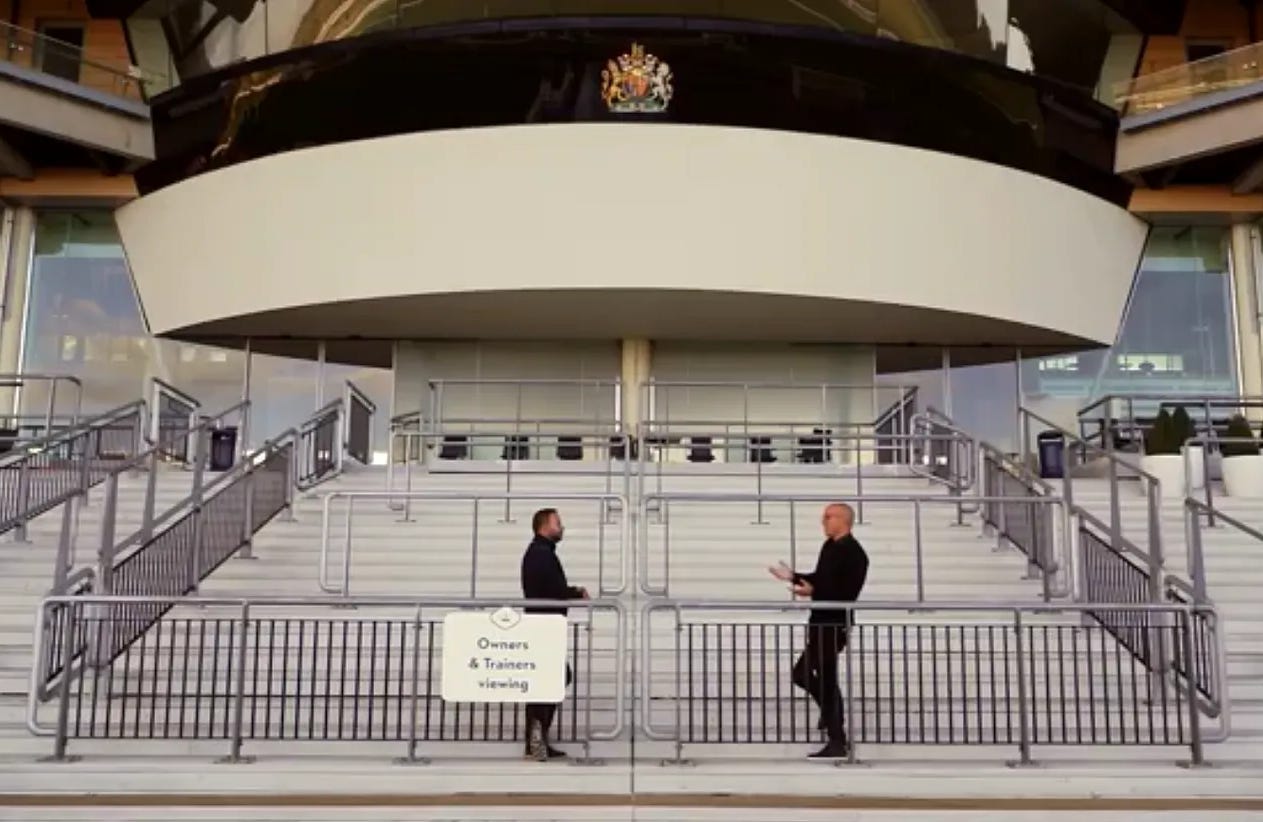
Sky Sports Racing introduced the interview as follows:1
In this feature, Persad speaks in-depth with Sky Sports Racing’s Josh Apiafi on the issues of diversity, race and inclusion in the sport of horse racing. Persad provides an eye-opening account of a broadcaster from an ethnic background working in the racing industry, recounting shocking experiences and looking to find solutions for the betterment of the sport and society today.
Despite the suggestive write-up, the one clear example of racial discrimination that Mr Persad provided was unrelated to horseracing; it was a moment when he was called the “p-word” at school.2
Otherwise, Mr Persad talked of “barriers [that] are more subliminal, subconscious”; he said:
“How many people who worked in stable yards have progressed from being a member of the stable staff to becoming a trainer? (Apiafi: “exactly!”). Why not? Because, guess what, the way it is that all trainers are white, 99.9% of trainers are white, and that people of colour are all stable staff and they don’t go on to become trainers”. (12m 45s)
Mr Persad’s description of trainers as “white”, rather than English, Scots or Welsh, obscured the fact that trainers are British, as one would expect. Mr Persad also overlooked: most people of colour are recent arrivals in Britain; being a trainer is not just a job but a lifestyle; there are many stable staff to one trainer, not the other way around; and most white stable staff do not become trainers either. Mr Apiafi did not challenge Mr Persad on these points.
Three unsupported assertions
Mr Persad made three unsupported assertions. Here is the first:
“What we have found in our time in the sport is the fact that people have been put by the wayside because of their colour, people have been put by the wayside because of sex, or whether they prefer to be gay or not”. (11m 40s)
Strictly speaking, that’s several assertions, but the focus here is on racial discrimination, because this is what the interview was principally about.
Had Mr Persad been able to substantiate his claim that people were put by the wayside “because of their colour”, that would have been the centrepiece of the interview. Mr Apiafi would have invited Mr Persad to expand on what he knew; what form does this “putting by the wayside” take? When did Mr Persad first notice it? How often does it occur? Who is doing it; is it organised centrally?
No such conversation unfolded, because horseracing has no mechanisms to put people “by the wayside” because of ethnicity: racecourses are open to all; job applicants are protected by employment law. Applicants wishing to become trainers, jockeys, and owners are not judged on racial grounds.
Regardless, Mr Persad, supported by Mr Apiafi, sought to impose an obligation on racing people to support Black Lives Matter:
“Racing is behind the times, I’m afraid to say. You think about the fact that the Black Lives Matter movement has been going for a significantly long time now, in 2020. How many people in racing have put up their hand, to say either I’m supporting Black Lives Matter or taking a knee or whatever, there’s been no gesture whatsoever by anybody in the sport, to say they’re supporting it. Now why is that, is it because they don’t care, is it because they are afraid to put their head above the parapet, or is there another reason”. (8m 55s)
That’s the second unsupported claim; the BHA did support Black Lives Matter (see Chapter 5) and it’s hard to see how Mr Persad was unaware of that, since he was a member of the Diversity in Racing Steering Group.
Mr Persad’s third unsupported claim was indirect, an omission, when he referenced the “pain and emotion” exhibited by West Indian former cricketer Michael Holding, during a television interview several months previously. Mr Persad said:
“We want [respected people] in racing … to say that we [the racing industry] have some solidarity with what's being said, we have solidarity with people who have suffered oppression. When Michael Holding … did those pieces on Sky, I was really moved … it really does move you emotionally to watch something like that … what surprised me was [Holding’s] pain and the emotion that came behind it. I was taken aback by that because he's normally such a man in control of his emotions”. (9m 50s)
Viewers were left to assume Michael Holding’s emotion was due to oppression by white people. In fact, Michael Holding’s emotions were triggered by the memory of his mother being ostracised by members of her (black) family for marrying a black man of a darker complexion.3 The effect of omitting this was to add emotional weight to the interview’s theme that racing people (i.e. white people) were indifferent, outdated, and discriminatory.
The role of the Racing Post
Following the interview, there was reaction on social media. Mr Persad told the Racing Post,
“I was really shocked. Being on television you get some stick and I've been on the receiving end of some negativity before but I've never been on the receiving end of as much negativity as this and it hurt … some of it has been unpleasant and some of it, I think, has been unnecessary”.4
Lee Mottershead, Racing Post journalist (and another member of DiRSG), referred to a twitter thread: “At least two people described Persad’s observations as ‘self-indulgent rubbish’, while the theme from some in the racing community was ‘there’s no issue here’”.5
Mr Mottershead further accused Mr Persad’s critics of “oozing bile and bigotry”, and quoted one tweet as saying “We’re in a white country”.
This latter tweet, however, was not quoted in full by Mr Mottershead; what it said was: “What difference does colour make, [whether they’re] white or black, forgetting we’re in a white country. If he went out to the Bahamas I bet it’s only black trainers and jockeys”.
Here is a screenshot of the tweet, and Mr Persad’s remark, to which it was replying:
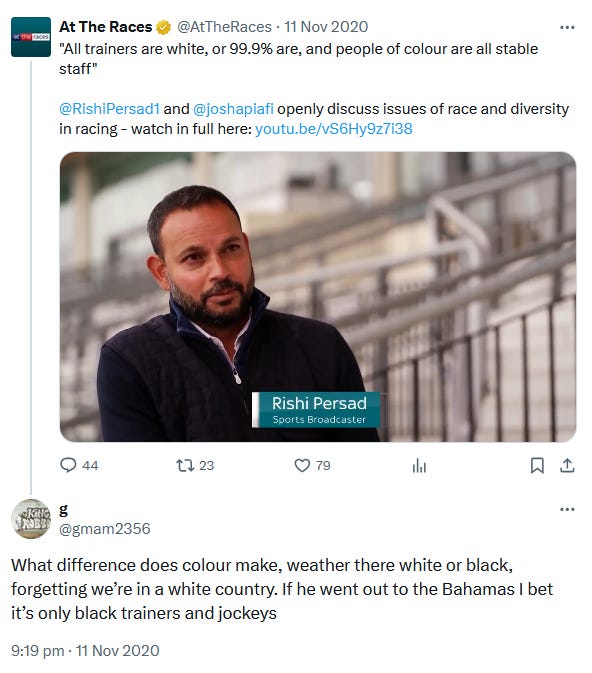
The point made in the tweet was that, by taking issue with participants in British horseracing being white, Mr Persad was applying to British people a standard he did not expect of non-white people.
Let’s illustrate with an example: trainers in Britain are 99% white for the same reason 99% of chefs in Indian restaurants in England are brown. There is no barrier to English people running Indian restaurants, but Indian food is a product of Indian culture and therefore of Indian people; they enter the hospitality and catering sectors and pass restaurants on to their children. English involvement is confined to being customers, and this is based not on diversity and inclusion policies, but consumer choice. This arrangement is considered acceptable for Indian restaurants, but not – in the eyes of Mr Persad or Mr Mottershead – for British training yards; why the double standard?
The social media replies to Mr Persad were a mix of coherent objections, exasperated protest, and bad language dismissals, but no racial slurs were identified - but Mr Mottershead’s references to “bigotry” and “We’re in a white country”, conveyed an impression that racial slurs had been used.
Racing Industry “Joint Statement on Diversity”
Four days after Mr Mottershead article, and nine days after the broadcast, the British Horseracing Authority (BHA) issued a press statement6 in conjunction with the Racecourse Association and Horsemen’s Group;7 it was signed by Annamarie Phelps, Maggie Carver, and Charlie Parker:
The BHA Board invited Rishi Persad to join its scheduled meeting on Wednesday [18 Nov 2020]8 to share his views on racing’s approach to diversity and his experience, having aired his own views publicly in the past few days. The Board condemns the responses Rishi has received …
But Mr Persad did not air “views”; he made a televised claim, effectively an allegation, that there had been exclusion of non-white people:
“What we have found in our time in the sport is the fact that people have been put by the wayside because of their colour …”
The joint statement continued:
The Board … strongly believes that the sport needs to have an open, progressive and respectful debate about diversity, for both moral reasons and in the interests of the long term health of the industry.
Yet, the joint statement said in its final paragraph:
… the industry’s leadership organisations will progress proposals put forward by the sport’s Diversity in Racing Steering Group to publish a unified commitment and a plan to improve diversity and inclusion, aiming to build on the work which has been carried out across the industry in recent years.
Thus, a statement claiming a need for “debate” also announced a prior decision to publish a “unified commitment” and plan to improve diversity and inclusion, thereby making “debate” redundant!
Racial dynamics override process
In a nutshell: on 11 November, Mr Persad and Mr Apiafi provoked a response, reported by Mr Mottershead on the 16th in a manner that was selective and misleading. Mr Persad addressed the BHA Board on the 18th, and executives of seven organisations issued their statement on the 20th.
Racing’s leadership failed to pursue the following options:
Applying basic procedures to regulate the process, such as having Mr Persad interviewed formally so his televised claims could be investigated and assessed.
No consideration appears to have been given to whether Mr Persad had brought horseracing into disrepute. The speed with which the leadership responded suggested horseracing had been portrayed in the worst possible light. The question was whether that portrayal was justified.
Why were these routes not taken? The wider Black Lives Matter campaign, endorsed by the BHA’s chief executive and chairwoman in June 2020 (Chapter 5), created an energy which portrayed white people as racially oppressive. Mr Persad’s interview leaned heavily into this, and the energy took over; horseracing’s senior leadership condemned the reaction to Mr Persad, while ignoring the offence he had caused; they sought his “personal reflections”, but did not hear from those who did not agree.
Indeed, engaging opposing views was becoming untenable, because doing so would acknowledge that a key underpinning of Diversity and Inclusion, the belief that black people could only go racing by overcoming white barriers, might in fact be wrong.
“Unified commitment”
The “unified commitment” on diversity was duly published in May 2021,9 signed by the CEOs of eight organisations. It was a slim document, referring to LGBT+, Women in Racing, and deploying loose terms such as “underrepresented”. It called for diversity champions and data collection on the workforce.
The document didn’t add much that was new; its significance lay in that a “unified commitment” could be said to encompass the whole industry, and so deny recognition of future dissent. From this point, diversity would be talked of only in terms of a settled industry consensus. The Diversity and Inclusion policy had been sealed.
Full interview - “Rishi Persad: Leading The Way”
Mr Persad provided two other examples, neither of which was related to horseracing nor, in this writer’s opinion, persuasive. One was where Mr Persad arrived late for a hotel conference, and another attendee, also arriving late, asked him where the lavatories were; Mr Persad described this as a “racist experience”. However, Mr Persad said that he was standing, waiting, in the foyer near the revolving doors, so it’s unsurprising the latecomer thought he was a member of staff. (20m 10s)
The other example (21m 45s) was when Mr Persad visited the United States for the Breeders’ Cup, the year after 9/11; he was quizzed in the hotel bar by a fellow guest, a journalist, on his foreign status. One of the controversies following 9/11 was how the hijackers had entered the country, given that the USA had been engaged militarily in the Middle East for years. The American journalist wanted Mr Persad, an Asian travelling on a foreign passport, to explain the procedures for his entry into the United States; in other words, he was testing the USA’s own systems. Even if one doesn’t approve of the American’s questions, this was an exceptional set of circumstances. Mr Persad evidently entered the United States without difficulty, and the hotel did not question his booking.
Sky News, 9 July 2020 - Michael Holding’s explanation is from the 13-minute mark.
Racing Post, 26 November 2020.
In case the reader is curious, the Twitter thread to which Mr Mottershead referred is here. The tweet quoted by Mr Mottershead as “there’s no issue here” said in full, “How many stable lads get the opportunity to become trainers these days regardless of their skin colour? It’s very hard for anyone to break through unless you have a massive backer or it’s a family business. There is no issue here”. In other words, the writer was arguing the issue was a matter of finance, not race.
Racehorse Owners Association, National Trainers Federation, Professional Jockeys Association, the National Association of Racing Staff, and Thoroughbred Breeders Association.
The minutes of 18 November 2020 stated: “The Board invited Rishi Persad to join the meeting to hear his personal reflections on racing’s diversity agenda. The Board noted that the Members’ Committee had agreed to issue a joint statement confirming the industry’s commitment to diversity and inclusion. It was agreed this should be expedited”.