
Chapter 5) Black Lives Matter, June 2020
Horseracing’s leadership uses industry platforms to promote BLM, claiming "systemic racism" and "white privilege".

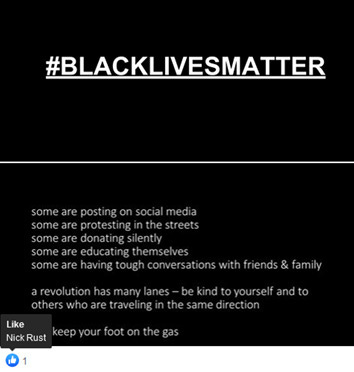
During the summer of 2020, British Horseracing Authority (BHA) staff were at home on furlough when, on 5 June, the Black Lives Matter square logo appeared on Workplace, the staff website. It referred to “tough conversations” and “revolution”:
The BLM logo was accompanied by an email from the BHA’s Head of Diversity and Inclusion which referred to “systemic racism”:
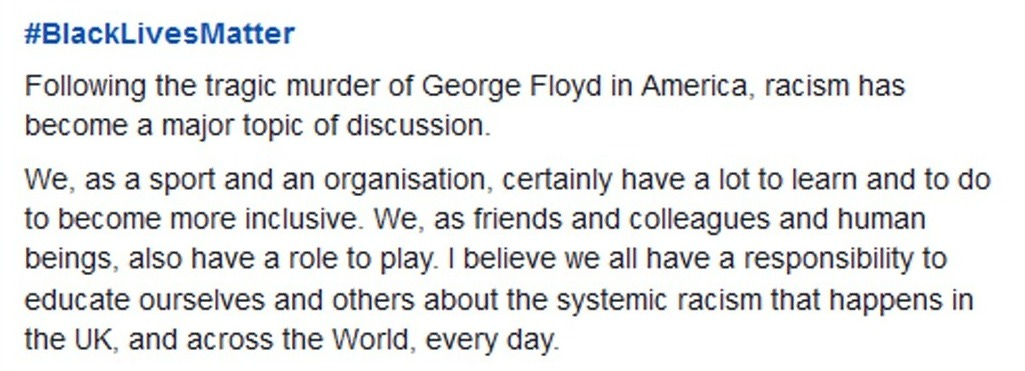
The statement assumed ignorance or indolence on the part of the reader: “a lot to learn”, “educate ourselves”, and so on. Note the word “murder”, even though Minneapolis police officer Derek Chauvin had yet to go on trial.
Within moments of the post appearing, BHA chief executive Nick Rust gave it a “thumbs up”. The post would have been run past him, and he was likely standing by to signal approval; the “thumbs up” indicated an argument with the BHA’s endorsement of Black Lives Matter was an argument with him.

What were the facts regarding George Floyd that the Workplace post failed to acknowledge?
There was no basis for saying that Derek Chauvin had intended to kill George Floyd (i.e. murder); it could have been manslaughter (as the court eventually found),1 or the death could have related to Floyd’s drug overdose.
There was no indication at the time - or since - that George Floyd was restrained by Derek Chauvin because he was black. Race was never raised as a relevant aspect in the subsequent court case.
Yet, a double assumption was made that, because Chauvin was white and Floyd black, it was “racism”; and because Floyd had died, it was “murder”; and declared as such to staff.2
The Head of Diversity and Inclusion went on:
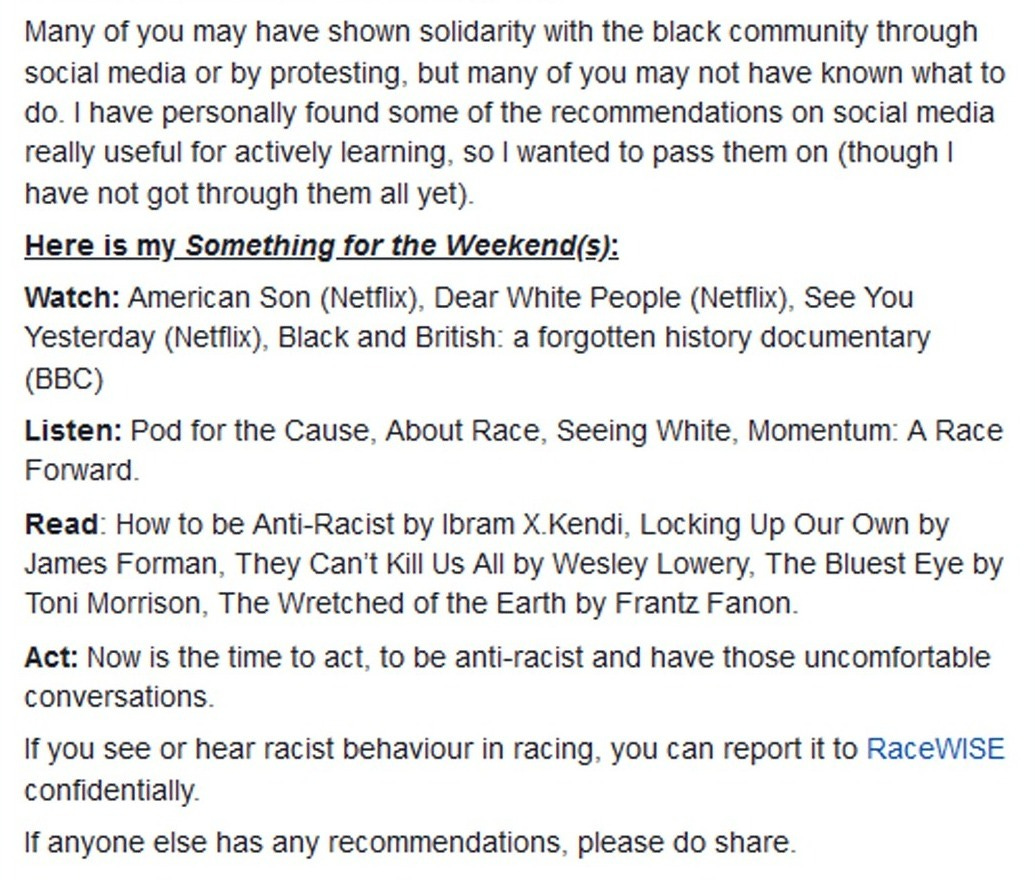
The above books and podcasts represent a worldview in which white people and society are “racist”, i.e. tainted or oppressive. I contemplated replying with book recommendations of my own, such as Douglas Murray’s Madness of Crowds: Gender, Race and Identity, which takes a critical look at identity politics played out in workplaces and universities; or his earlier book, The Strange Death of Europe: Immigration, Identity, Islam, which examines changes being made to Europe’s demography and culture.
But these books would cut across the line being imposed. I say “imposed” because staff were being told what to think; that “racism” was a trait of white people, it was endemic, and we needed “uncomfortable conversations”.
Double standards
The use of BHA platforms to draw attention to George Floyd created double standards that were impossible to justify.
The BHA made no announcement regarding the death of Tony Timpa, a white man who died in Dallas in August 2016. Timpa, 32, had been held face down with his hands cuffed behind his back, his legs zip-tied, and a police officer kneeling on his back while placing his hands on Timpa’s shoulders. Timpa protested (“Help me”, “You’re gonna kill me”) but the police held him there for 15 minutes and Timpa died on the ground. Camera footage is available.3
Nor did the BHA make a statement about Alexander Monson, a British man who died in police custody in Kenya in 2012. The Kenyan police said Monson had died of a drug overdose but a pathologist hired by the Monson family found he died from a fatal blow to his head. Following a campaign by the family, an inquest ruled in 2018 that Monson was beaten to death by police; in 2021, four police officers were convicted of manslaughter.4
I select the above two cases because each reflects the George Floyd circumstances: in the case of Timpa, a white man dying in near identical conditions; in the second, a white man dies in the custody of black police officers in controversial circumstances.
The BHA leadership assumed, wrongly, that race played a role in George Floyd’s death so, for further comparison, we must turn to an example where race is relevant. I joined the BHA’s predecessor the Jockey Club in early 2002. At that time, Robert Mugabe was giving the nod to mobs in Zimbabwe to commit violence against white farmers; in March 2002, the Guardian reported, “the tenth white farmer killed during a two-year campaign of intimidation and occupation of white-owned land … shot dead near his homestead while trying to escape an attack”. The Jockey Club did not make a statement on these killings; was it wrong not to do so then, or was the BHA wrong to do so regarding George Floyd in 2020? Both positions cannot be correct simultaneously.
Lack of relevance
But there’s a more straightforward objection to the BHA’s stance: George Floyd and Black Lives Matter have no relevance to the regulation and governance of horseracing. It would have been entirely appropriate for chief executive Nick Rust to be suspended, pending an investigation into possible misuse of authority; but prior standards of governance had been overwhelmed by the notion of “systemic racism”.
Later that day, 5 June 2020, Mr Rust wrote on Workplace:
Our sport (and the BHA) is quite a bit behind others on diversity and inclusion based on the hard evidence available to us. This needs to change. As founding Chair of the Diversity in Racing Steering Group, I wish more had been achieved in making change happen over the last few years, and I’m determined that the BHA does all it can in the rest of my time here and beyond.
We need to not only make an initial industry statement, but consider what we expect of those we licence, our shareholder organisations and others connected to the sport. There should be no funding to organisations who do not have the basics in place on diversity and inclusion (all groups), and we should not licence anyone who fails to uphold the highest standards.
Mr Rust added:
Black Lives Matter. We cannot accept racism or other discrimination in any form within the BHA or the sport, and our actions must now fully match our words.
Two things are being conflated; the view that black people ought to be involved in racing, and the belief that discrimination prevents black people from being involved. Mr Rust’s latter remark implies racial discrimination was accepted in horseracing, but no examples were provided to demonstrate this, and racial discrimination is already against the law. I was troubled by the threat to deny licences to participants who didn’t agree with what was happening, so responded with a post of my own:
I believe that would be an over-reach of the BHA’s purpose, and don’t agree with it.
Mr Rust replied:
Thanks John. Just my view. Depends what we “expect”, of course, as to whether it’s an over-reach, but I take your point!
Few realised it, but a coup had just taken place. A death in a foreign country, yet to be tried, had been projected onto British horseracing, bringing with it a new moral order that changed fundamentally the relationship between the governing body and the industry. Participants, now under the presumptive cloud of “systemic racism”, faced having to validate themselves with “diversity and inclusion” requirements or, potentially, be excluded from the sport. I’ll expand on this in future Chapters but, for now, will continue the chronology of events.
Annamarie Phelps’ article in the Racing Post

Just over a week later, 14 June, BHA chairwoman Annamarie Phelps told staff on Workplace:
In the light of the tragic killing of George Floyd and the discussions that have been ongoing about white privilege across our society, it is right that we acknowledge we haven’t prioritised tackling racism or diversity in racing as a sport, or at the BHA, as we should have.
The same day, Annamarie Phelps wrote in the Racing Post:5
It is also right to consider and respond to the major social issues of our time, whether that's environmental sustainability or, most pressing, the explosion of anger in the United States and here following the killing of George Floyd … These conversations are not easy to understand, particularly for those of us who have not suffered the daily prejudices that those from black communities, in particular, face.
By stereotyping white people as having “privilege” and black people as facing “daily prejudices”, Annamarie Phelps was passing judgment both on horseracing and British people as a whole. Any disagreement as to the accuracy of her statement is parried by her claim that “these conversations are not easy to understand”.
The phrase “right to consider and respond to the major social issues of our time” is giving executive staff the power to use the BHA for any activism they choose. Who decides the “social issues of our time”? What constitutes an “explosion of anger”? Whose anger? And what, precisely, is the “social issue” relating to George Floyd that is not already remedied in law and practice? Police officer Derek Chauvin had been arrested, hadn’t he?
“Let’s Talk about Race in Racing”
Two days later, 16 June 2020, the Diversity in Racing Steering Group (DiRSG) produced an eight-page pamphlet called Let’s Talk about Race in Racing, published on the Racing Foundation’s website and featuring BLM’s clenched fist black power logo:

The DiRSG, which included senior horseracing staff, made accusations against the industry:
Given the current climate world-wide with regards to race relations and racism and the effects being felt here in the UK, DiRSG believes this is an opportune time to remind everyone that British racing has already acknowledged that there is an issue … Black, Asian and minority ethnic people continue to be under-employed and, despite a clear desire for progression, continue to be underrepresented at senior levels … DiRSG acknowledge the racial injustices experienced by Black, Asian and Minority Ethnic (BAME) people and the suffering it causes. These recent events have prompted us to ask, are we doing enough? The answer is simply, no … Like many other sports, the current debate about race and racism is prompting the DiRSG to focus specifically on how we are addressing discrimination and prejudice as they affect Black, Asian and Minority Ethnic (BAME) communities.
The DiRSG pamphlet asked:
The lack of ethnic diversity amongst racegoers is apparent and other areas of the sport … If you go into racing yards across the country, you will meet a huge range of people with different heritage and ethnic backgrounds, yet how many are there amongst the 600 Racehorse Trainers or 450 Jockeys?
And:
… it’s not always obvious what the answers are to the questions: how come there are few BAME people in our organisation? or why do few BAME people come racing?
The answers to these questions should be perfectly obvious:
Britain is part of Europe where “white people” (i.e. Europeans) have been in residence for tens of thousands of years.
The reduction in the “white British” share of Britain’s population is recent; from 95% in 1991 to 77% in 2021 (74% in England). Most of this change occurred during the period the present writer was employed in horseracing; one could see the changes in London and the south-east, especially from 2015.
Non-Europeans arriving in their millions do not sprinkle themselves into every corner of society. Such a thing is not logistically possible, and why would they, anyway?
The question is not, “why aren’t there BAME people in racing”, but “why should there have been BAME people in racing”. That is the question DiRSG needed to address before making “racism” accusations, but didn’t.
There are 59 racecourses in Britain running around 1,500 fixtures each year; neither the BHA leadership nor DiRSG were able to cite a single instance of people being turned away from racecourse gates on account of their race, or any other comparable practice of discrimination; instead, they floated the suggestion of racial discrimination and left it hanging in the air, and this became the justification for the escalation of the diversity policy.
The offence of which Derek Chauvin was convicted, relating directly to Floyd’s death, was “unintentional second-degree murder”, which is the approximate equivalent of involuntary manslaughter in Britain.
Although the death of George Floyd was held to illustrate wanton killing of black people by American police, nothing was produced to back this up. It wasn’t until much later that I looked up the figures for myself; the Washington Post compiles a database that shows about a thousand people are shot dead by U.S. police each year. In 2019, that figure was 993, 257 of whom were black and 431 white. The vast majority of those killed were armed with guns, knives, and other weapons; 48 police officers were also killed. If we look at unarmed people, 54 were shot dead by U.S. police in 2019, 11 of whom were black, and 26 white. Adjusted for shares of population, black fatalities are two to three times higher than white fatalities, but not in comparable situations, such as equivalent encounters or threat levels. The notion that killing of unarmed black people was typical and widespread could only have been reached by ignoring white fatalities and ignoring the use of weapons by black people in most cases. https://www.washingtonpost.com/graphics/investigations/police-shootings-database/