
Chapter 6) Horseracing's LGBT+ eLearning, June 2020
Examining the accuracy and assumptions of DiRSG's online module for jockeys, trainers, and other horseracing staff.

In June 2020, horseracing's Diversity in Racing Steering Group (DiRSG) launched its “LGBT+ Awareness and Inclusion E-Learning”, a module made available via Racing2learn, the horseracing industry’s online training platform. The BHA press release said:
To mark Pride month this June, the DiRSG dedicated LGBT+ sub-group has today launched a new e-learning module to improve LGBT+ awareness and inclusion within British racing … The LGBT+ dedicated sub-group has been developed following research in the sport which indicated many individuals who identified as a sexual minority did not feel comfortable ‘coming out’ at work, despite largely positive attitudes towards sexual minority individuals throughout the sport.
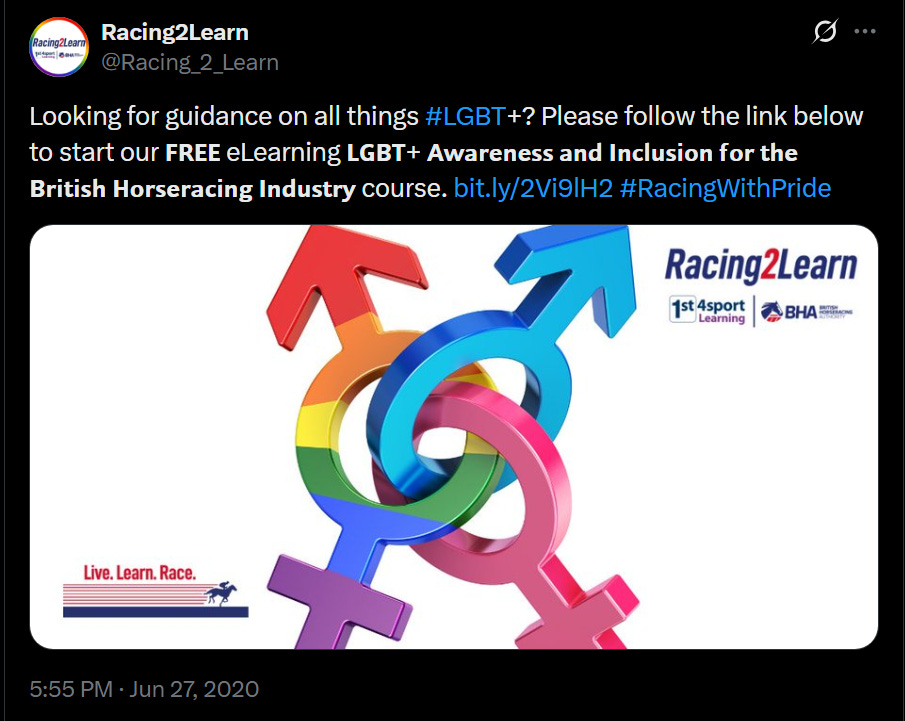
Here is the module’s announcement:
The following images are selected screenshots from the module. It started with this slide which refers to violence and abuse against LGBT+ people.
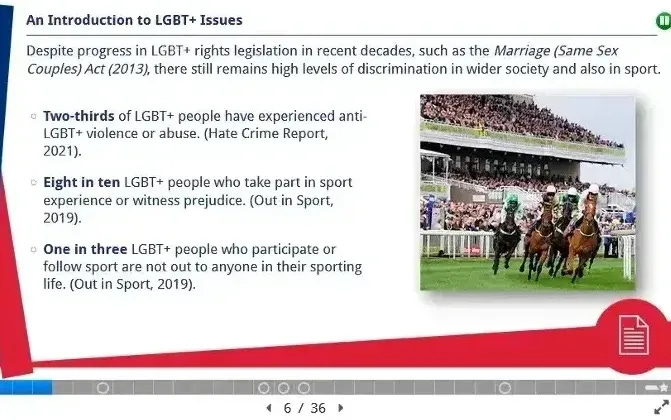
The citations in the above slide are wrong. The Hate Crime Report 2021 did not show that “two-thirds of LGBT+ people have experienced violence or abuse”, but rather “two-thirds of respondents” (p7).1 The online survey was aimed at followers of LGBT anti-abuse groups,2 so it would have been surprising if most respondents hadn’t experienced abuse at some point. The poll said nothing about the LGBT population at large because it was not a nationally representative or weighted survey.
The slide’s reference to Out in Sport 2019 is a mistaken reference to a book of that name, published in 2016.3 The 2019 survey they’re thinking of is OutSport,4 but the “eight in ten” figure cited doesn’t come from that survey; it comes from an earlier survey in 2015 called Out on the Fields.5 In 2016, the book Out in Sport observed that the 2015 survey was flawed; for example, it asked respondents whether they “witnessed or experienced” incidents, which risks double counting. The 2019 OutSport survey sought to resolve this by separating experiencing from witnessing, and other refinements; it found 16% of LGBT respondents had one or more negative personal experiences in the previous 12 months, not 80%.
(The above mistakes suggest DiRSG hadn’t read the reports; this wasn’t the first time DiRSG failed to cite reports accurately; see Chapter 2).
Gender Theory
The e-learning’s main purpose was to introduce a new vocabulary and framing of human biology. Previously, the unstated but assumed position was that men were men, women were women, a small minority of men and women were homosexual, and an infinitesimal number identified as the opposite sex.
The new training taught something different: people have “gender identity, sexual orientation and gender expression [that] can change over time”.
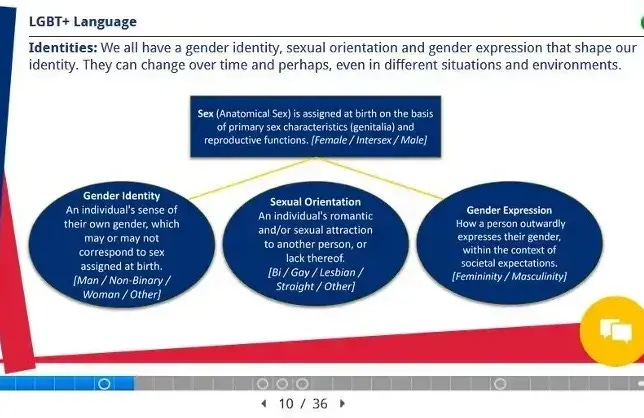
The top box says “sex is assigned at birth”, thus denying “male” and “female” as biological definitions. In their place is “gender identity” (to the left) that need not match “assigned” sex. This combination of “assigned” sex and “gender identity” has the effect of deconstructing male and female.
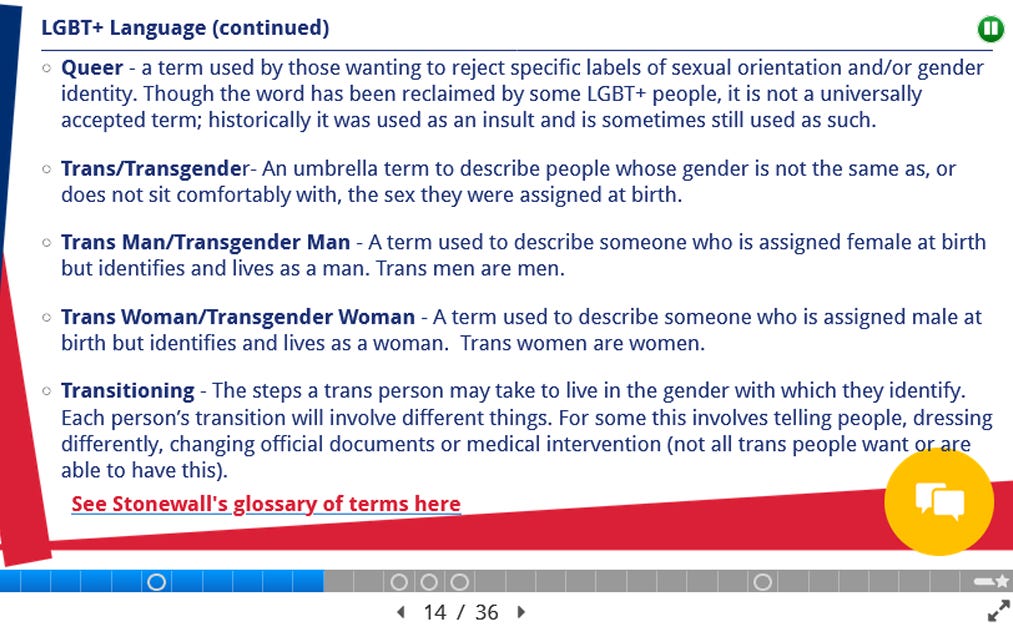
Consequently, the below slide says “trans men [i.e. women] are men” and “trans women [i.e. men] are women”. Note also the link to Stonewall:
In the below screenshot, men and women - who describe themselves as such - are redefined as “cisgender” or “non-trans”; the effect is to categorise men and women as a single gender among a larger number of gender identities.

What Racing2Learn teaches is contested and, in this writer’s view, false; sex is not ‘assigned’ at birth, it is observed. What’s the difference? A three-sided shape is observed to be a triangle; it is not ‘assigned’ the shape of triangle, as though a matter of choice. If it has three straight sides, it is a triangle. A three-sided shape cannot be ‘reassigned’ as a square, as this would mean a triangle could have four sides or three sides.
In the same way, a man cannot ‘reassign’ himself as a woman. Men and women, boys and girls, are biological; males have XY chromosomes, females XX chromosomes. This reality cannot be wished away or denied by substituting ‘identity’ in place of sex. The e-learning module’s assertion that “trans men are men” and “trans women are women” is therefore wrong; “trans men” are women who identify as men, but they are still women. “Trans women” are men who identify as women, but they are still men.
None of this should be taken to disregard individuals who identify as the opposite sex; such individuals are entitled to respect and reasonable accommodation, but they are still the sex they were born as.
The e-learning module went on to explain about the gay rights movement, Pride, and LGBT+ History Month:
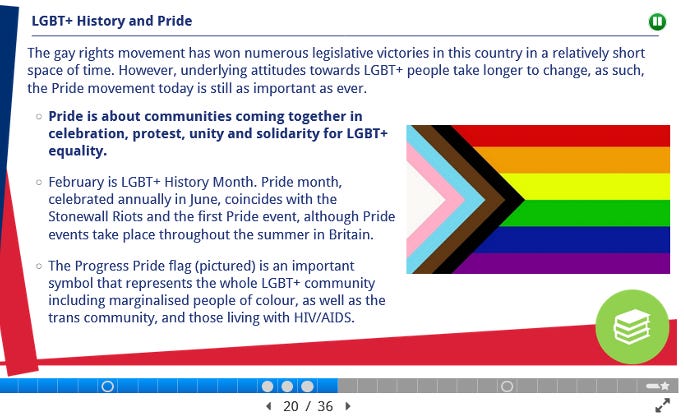
Such e-learning is not comparable to, say, instruction on handle a horse, or how to use a fire extinguisher; it is political in nature. The passage below, explaining “Why Pride is still important”, tacitly endorses the introduction of LGBT and gender theory to school children.

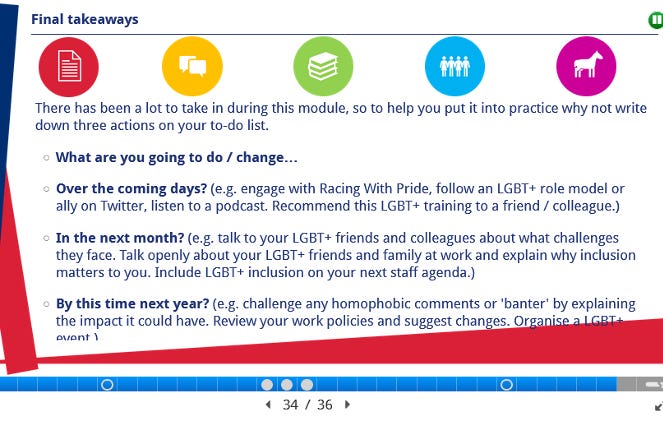
The module drew to a close by encouraging participants to engage in LGBT+ activities:
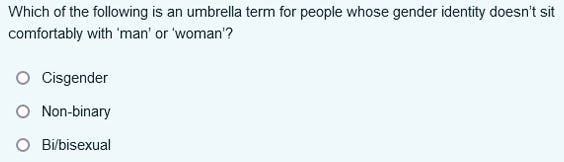
Finally, there was a test, with the following type questions, designed to affirm the “learning”:
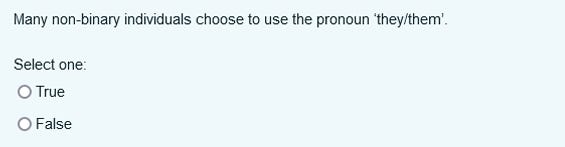
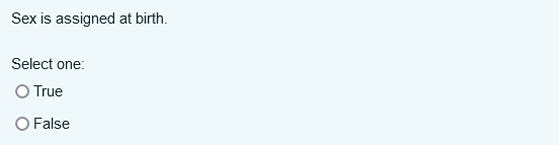
In that last question, the expected answer was “true” when the correct answer is “false”.
Despite the e-learning’s ideological and contested nature, it was included in the mandatory licensing courses for trainers and jockeys at the British Racing School and National Horseracing College.6 Great British Racing, horseracing’s marketing arm, said the module would be completed by its “full team”.7 By 2022, over a thousand people had completed the course.8
Page 7 - Hate Crime Report 2021, Galop
Ibid p62