
Chapter 2) The Diversity in Racing Steering Group, and Action Plan, 2017-2018
The BHA sets up a Diversity Group, generously funded but with an ambiguous mandate; a "commercial case" without evidence; and Diversity claims a scalp.

In August 2017, three months after its May press statement (see Chapter 1), the British Horseracing Authority (BHA) announced the creation of a “Diversity in Racing Steering Group” (DiRSG), fulfilling one of the recommendations of the Oxford Brookes report.
The DiRSG’s initial members included BHA chief executive Nick Rust, senior officers from the BHA, Jockey Club and Racehorse Owners Association, Susannah Gill from Women in Racing, and various racing and media people.
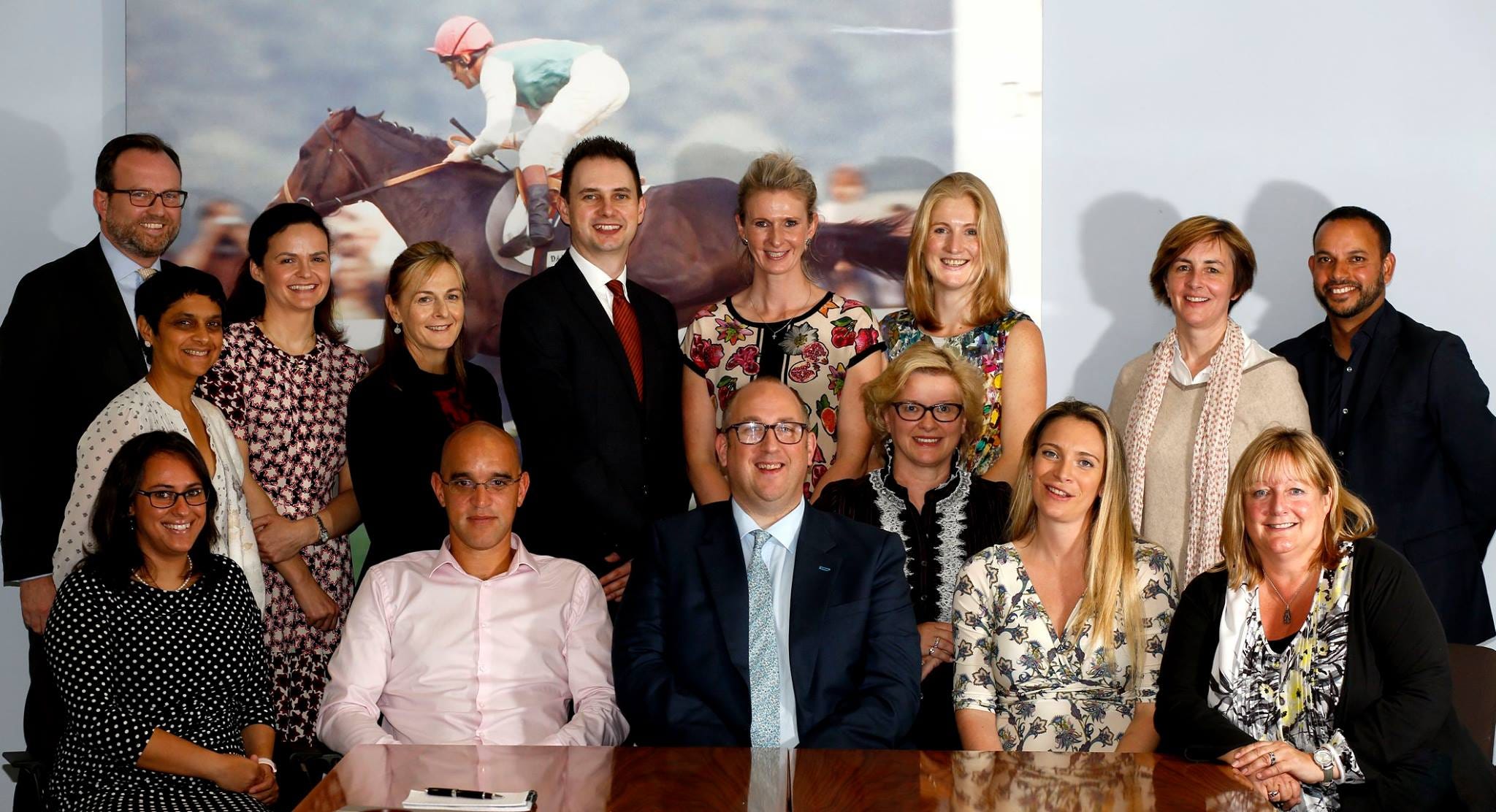
The BHA said that DiRSG was expected to “lead and direct our sport in this vital area”;1 yet, DiRSG said in its first publication (below) that it was an “advisory group with no executive or decision-making function”. DiRSG’s remit was confusing; “advisory” implies something passive, i.e. the industry would consider actions, and the Group would provide advice. But DiRSG’s stated aim of “leading and directing” implied that it held responsibility for determining policy, subject to an authorising decision.
In practice, DiRSG’s lack of a final decision-making function relieved it of any restraint on what it could say or propose, giving it more leeway than had it been a formal department. DiRSG didn’t display the BHA logo, but it could use BHA premises for meetings, use BHA platforms for distribution of its reports, speak to the media, and would soon have its own budget; £275,000 was provided by the Racing Foundation in 2019.2
The cancellation of James Underwood, November 2017
The BHA and DiRSG had an early opportunity to assert the diversity policy when racing journalist James Underwood wrote the following, in response to DiRSG’s formation, in his European Racing and Breeding Digest:
One doesn't imagine that black people or other ethnic minorities are interested in going racing. They prefer football, like most people here who spend slabs of time watching it and other ball games, in a life that can be written off as balls. Racing could send a boat to Libya to save a number of black people in the awful refugee centres there to be settled in accommodation at Kelso and Southwell - but they'd soon be hitching a lift to East London. As for the gays, they would soon find that the racing crowd isn't very sympathetic to their way of life and, if they couldn't get into the stables to meet the lads there, they'd soon be bored.
The BHA responded:
… following the publication of James Underwood's European Racing and Breeding Digest earlier this week, the BHA has terminated its subscription. Our decision follows racist and homophobic comments in an editorial piece related to the formation of the Diversity in Racing Steering Group, a group which holds at its core a vision for a more inclusive and diverse sport ... At the first meeting of the DiRSG, its members made a commitment to calling out and challenging behaviour which goes against values that our sport has embraced - inclusivity and respect.
The BHA didn’t just cancel its subscription to Mr Underwood's publication; it wrote to organisations across the industry with the result that Mr Underwood stopped receiving invites to media events and annual meetings.3
James Underwood was 89 years old, and his remarks could have been treated as an educational matter, taking into account his sentiments were common during his long life, as illustrated by TV programmes like “Fawlty Towers” and “It Ain't Half Hot Mum”. Mr Underwood was quoted in the press as saying, “I was trying to get from one subject to another. I realise now that I got it wrong, but I come from a different age”.
Mr Underwood’s cancellation represented the diversity policy’s first victory, and it signified something else; the BHA’s response was only two days after Mr Underwood’s piece, meaning no opportunity was provided for a right of reply. The BHA’s action fell short of a formal exclusion order, but it was an exclusion in practice, by shaming, suggesting that the diversity policy and DiRSG could become a de facto substitute for normal procedures.
Diversity and Inclusion Action Plan, July 2018
In July 2018, DiRSG released its first report, an 8-page Diversity and Inclusion Action Plan to “improve representation across all aspects of the sport”.4 Note the word inclusion; this had not appeared in the BHA’s May 2017 press statement announcing the diversity policy, nor was it a concept proposed by the Oxford Brookes report. The Action Plan stated:
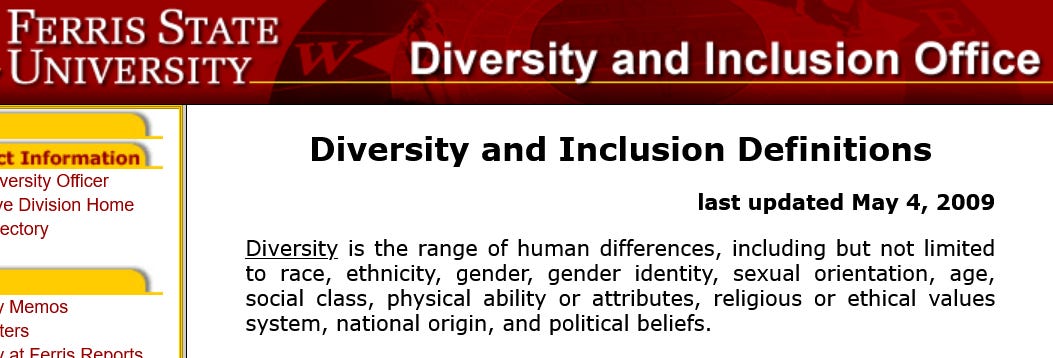
Diversity covers a broad range of human differences, including but not limited to race, ethnicity, gender, gender identity, sexual orientation, age, social class, physical ability or attributes, religious or ethical values system, national origin, and political beliefs.
An internet search suggests this definition is from the United States, possibly Ferris State University, Michigan, which had been using the wording at least since 2009.5 This indicates ideas were not being drawn up by DiRSG or even within British horseracing, but brought over from American academia:
The Action Plan went on:
… currently some of the traditions and practices of the sport are out of kilter with modern British society. From the composition of the sport’s leadership and the opportunities afforded to participants, through to the make-up of people attending and enjoying racing, British racing could appear to many in our country to represent the past, not modern British society.
The terms “modern Britain” and “the past” disregard the fact Britain’s 59 racecourses exist in the present; the Action Plan was obviously using these terms to mean the social and demographic changes DiRSG wanted to see; for example, to make horseracing less white, less male.
DiRSG member Susannah Gill said in May 2018, “We are still perceived in Britain as a white man’s rich sport … management of racing [is] very white, predominantly male and middle-aged”.6 Another DiRSG member Sulekha Varma suggested horseracing had an image of being “stuffy and white only”.7 Annamarie Phelps, BHA chairwoman said (in 2020), “Racing here is often seen as a sport that is predominantly white and privileged”.8 The BHA’s claim in May 2017 that diversity was needed to be “fair” was upgraded by the Action Plan to a “clear moral case”.
Until the diversity policy, people in racing were not regarded as “white”; they were just people in racing. Note also the associated terms: “white and privileged”; “rich”, “stuffy”, “middle-aged”. One might expect this framing from racing’s detractors such as animal welfare activists, but not from prominent people in the industry. And “white” is not even accurate; if it were, racing people in Britain might be Norwegian, Austrian or Italian; instead, they are English, Scots, and Welsh, exactly as one would expect.
The above attitudes represented a profound change in outlook. Previously, horseracing was regarded as normal and good; now, racing was being presented as abnormal and unfair; this conclusion was reached via the suggestion that racing was “not modern” because it “represented the past", which was based on the suggestion it was “white” and male.
The “moral case”
What, precisely, is not “fair” or “moral” about horseracing’s arrangements? British horseracing is a free association of men and women who come together for said activity; the process of public involvement is as follows:
Racing is advertised on television, in newspapers, and online; advertisements appear on railway stations platforms, on the side of buses, and along London Underground escalators.
People look at the advertisements and decide whether they want to go racing, or apply for jobs.
Racing attendance and participation reflects people’s choices whether to engage in the sport.
So long as people are free to exercise consumer choices, and job applicants protected under employment law, there is no basis for saying there is unfairness.
The “commercial case”
The Action Plan also said there was a clear commercial case for diversity and inclusion, and its footnotes cited reports; what do these reports say?
The Business Case for Equality and Diversity: a survey of the academic literature, produced by the British government’s Department for Business, Innovation & Skills in 2013,9 concluded:
The academic research analysed [contained] little consideration of the role of internal processes and policies. This kind of evidence cannot explain how business benefits were realised … they tend not to focus on business performance impacts, or to look at firms’ context and strategic response, what worked and why … The insight from this report suggests that the business case for equality & diversity might have more resonance with businesses if there was credible evidence of this more practical kind. (pages vii-viii)
So much for that! Another report was Delivering through Diversity by American management consultancy firm McKinsey, 2018,10 which provided no causal evidence between boardroom diversity and performance; it said:
Correlation is not causation. There are real limitations, and we are not asserting a causal link. (p38)
McKinsey claimed a correlation between leadership diversity and corporate performance, but when two economists sought to verify its research in 2024, McKinsey denied them access to its data. The economists tried to recreate McKinsey’s study by using U.S. companies in the S&P 500, a sample that McKinsey was likely to have used, but they could not find the claimed correlation.11 Even if McKinsey’s correlation did exist, DiRSG missed the obvious point that cause and effect could be the other way around, i.e. high-profit corporations which engage in unpopular practices, such as relocating production to countries with poor working conditions, adopt “diversity” as means of deflecting criticism.12
DiRSG also failed to acknowledge that, prior to the diversity policy, British people had been able to organise and produce:
racecourse venues, tracks, and stables;
silks, helmets, boots, saddles, and whips;
handicapping and stewarding systems;
systems of ownership and licensing;
veterinary services;
as well as the breeding, training, and riding of racehorses.
For all the claims of diversity being a strength, no research had been produced to explain how diversity would improve upon what had been achieved in British horseracing over the past 250 years.
Appointment of Head of Diversity and Inclusion, October 2018
The final event of 2018, in October, was the BHA’s appointment of a Head of Diversity and Inclusion. This was a salaried position, intended to:
… fulfil British racing’s ambitions to become more diverse and inclusive [and to work with DiRSG] to co-ordinate and implement the recommendations of the Action Plan and to work with the Racing industry.13
This position was not comparable to, say, a Head Veterinary Officer, or a Head of Finance, which dealt with functions; it was an ideological position that would soon import into horseracing LGBT+ and “anti-racism” orthodoxies.
There was a third report cited by DiRSG; “FTSE Women Leaders: Improving gender balance in FTSE Leadership”. Its claim that there was a “strong association between gender diversity and corporate out-performance” was based on another publication, “Credit Suisse Gender 3000: The Reward for Change” which, like McKinsey, relied on correlation, not causation (e.g. p27).